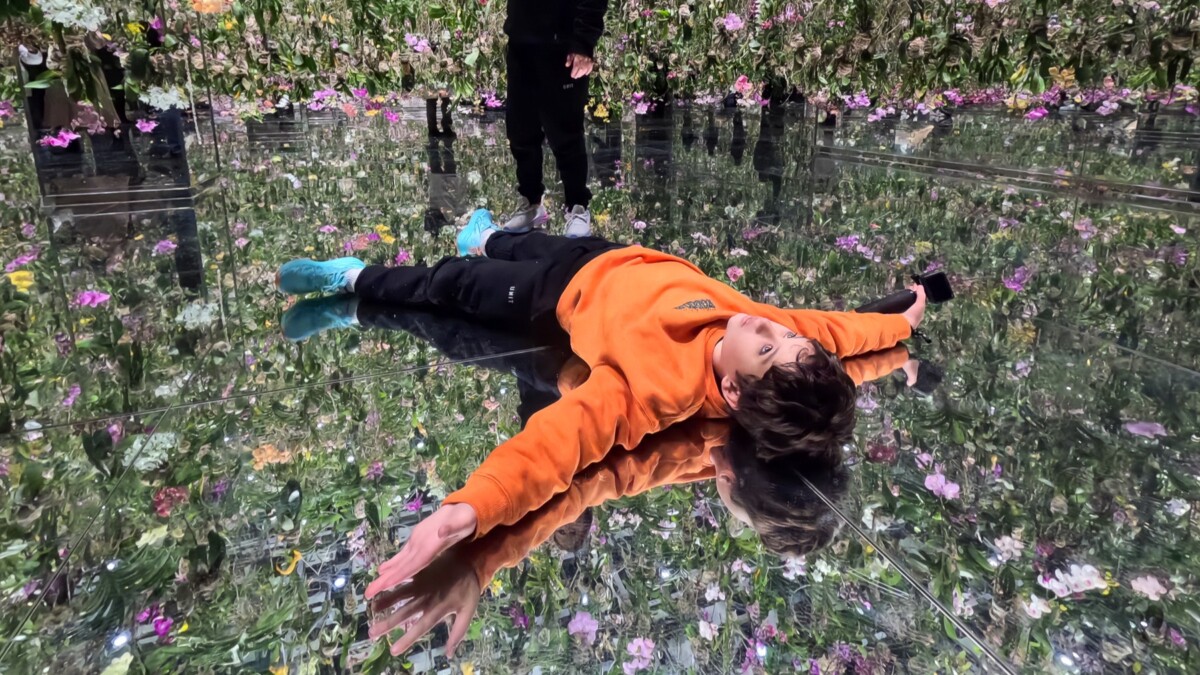
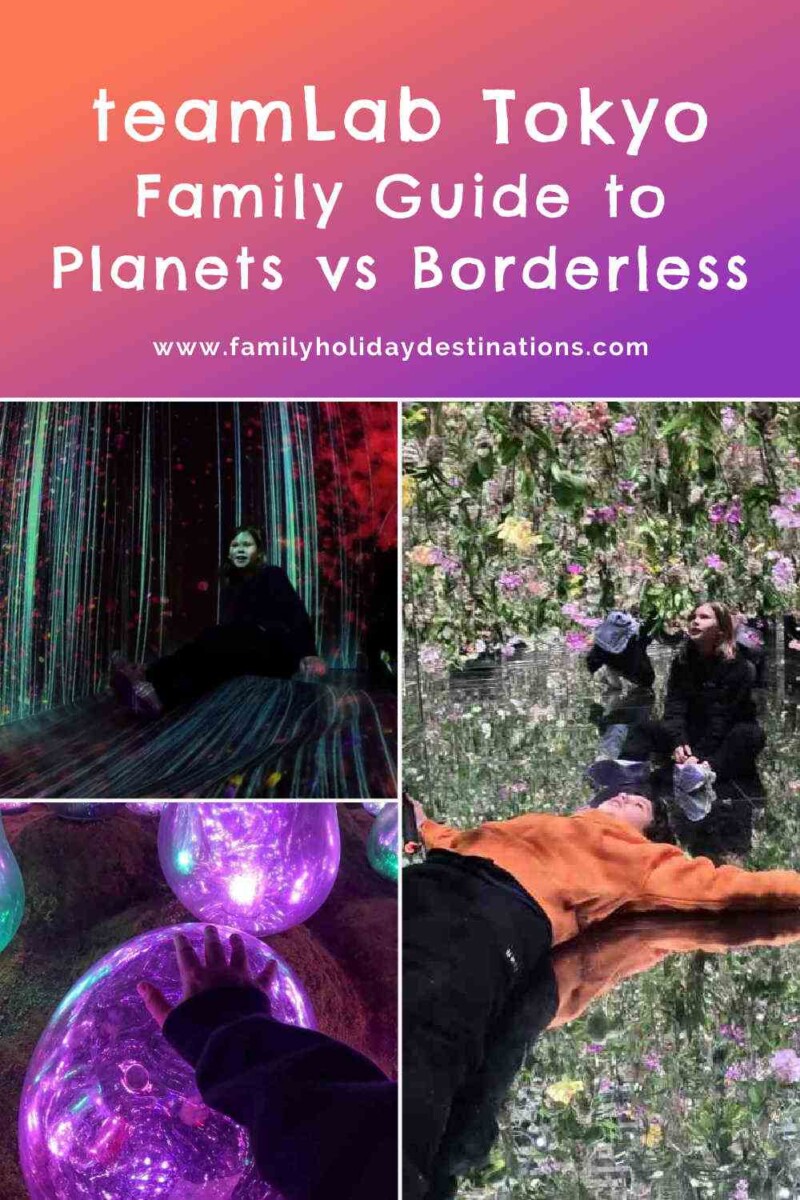
If you’re wondering whether to book teamLab Borderless or teamLab Planets in Tokyo with kids, we visited both as a family to compare them. In this guide, I’ll break down the differences, what each is like with children, and which one I’d recommend depending on your kids’ ages and sensory needs.
teamLab is a renowned immersive digital art installation based in Tokyo, Japan. It works with advanced technology to create incredible interactive experiences on a large scale, challenging traditional forms of artistic expression. The installations frequently change in response to the viewer’s movements, creating a fun environment in which you’ll never find a dull moment.

Wading barefoot through knee-deep water while digital koi swam beneath our legs, only to explode into what appeared to be flower petals when we reached out to touch them, was not how I pictured our first day in Japan going, but that’s the wonder of visiting teamLab Tokyo with kids for you.
Quick answer: teamLab Borderless vs Planets with kids
- Choose teamLab Planets if your kids are primary-school age or older and will enjoy the interactive water and sensory elements.
- Choose teamLab Borderless if you have toddlers or kids who prefer exploring at their own pace and you don’t want the stress of the water component.
- For our family: the adults preferred Planets, while the kids preferred Borderless.
- Best overall for most families: Planets for older kids, Borderless for younger ones.
teamLab Borderless vs Planets: key differences for families
| Feature | teamLab Planets | teamLab Borderless |
|---|---|---|
| Location | Toyosu | Azabudai Hills |
| Duration | 2-3 hours | around 3 hours |
| Interactivity | High (physical movement, water) | Medium-High (exploration, discovery) |
| Toddler-friendly? | Less so due to water, darkness | More so |
| Stroller access | No | Limited |
| Photography | Allowed (no flash) | Allowed (no flash) |
| Who liked it better? | Parents | Kids |
Which is better by age?
If you’re travelling with kids, this is where the decision really becomes clear.
Toddlers (under 4) → Choose teamLab Borderless
Borderless is much easier with little ones. There’s no water to navigate, no need to carry them, and the open layout lets them explore at their own pace.
Young kids (ages 4–7) → Depends on your child
If your child is confident and loves sensory play, they’ll likely enjoy Planets. But if they’re sensitive to darkness, flashing lights or unfamiliar environments, Borderless may feel less overwhelming.
Older kids (8+) → Choose teamLab Planets
This is where Planets really shines. The interactive elements, especially the water room, feel more exciting and memorable for older kids who can fully engage with the experience.
Sensory-sensitive kids → Lean towards teamLab Planets
While both can be overwhelming, we found Borderless more intense due to its size, crowds and constant movement of lights and projections.
Our family experience at teamLab Planets vs Borderless
As mentioned above, both teamLab venues in Tokyo are immersive digital art installations that span many rooms. You don’t need to be ‘into art’ to enjoy them, and you can explore them at your own pace. If you have the time to visit both, you absolutely should, as they are both very different experiences.
teamLab Borderless seems to revolve around the idea of a fluid, seamless space where the boundaries between artworks are ‘borderless’. If you go back into the same room twice, you are likely to find artwork that has since floated or walked in from another room and is now interacting in a different way and with other pieces. It feels maze-like and has a larger, more open layout.
A highlight for kids at teamLab Borderless in Tokyo is the Sketch Aquarium. Visitors can draw and colour a fish, which is then scanned and brought to life in an interactive aquarium room that responds to your touch, even showing up in other teamLab exhibitions around the world.
teamLab Planets in Tokyo is more interactive in that it encourages kids and parents to engage with the art through movement and their physical presence. Planets is smaller and features designated rooms that highlight specific sensory experiences, such as a room with knee-deep water in which digital koi fish swim around your legs. It feels a bit more intimate, and you can engage more closely with the art.
In summary, while both teamLab Tokyo’s offer immersive digital art experiences, they offer different themes, designs and interactions, each providing a unique platform for kids and parents to experience contemporary art.
Which is better for toddlers, younger kids and older kids?
The adults enjoyed teamLab Planets more than teamLab Borderless because it was more interactive. Starting with the water room, we removed our shoes and were ushered along an inclined corridor in ankle-deep chlorine-smelling water. At the end of the corridor, we were handed a towel to dry our feet (the corridor must have been to wash them) and shown where to dump the now dirty towel. After that, we were free to explore the water room with the digital koi fish, which we all really enjoyed. Once you leave the water exhibit, you return to a locker to put your shoes back on and wander through the remaining exhibits.
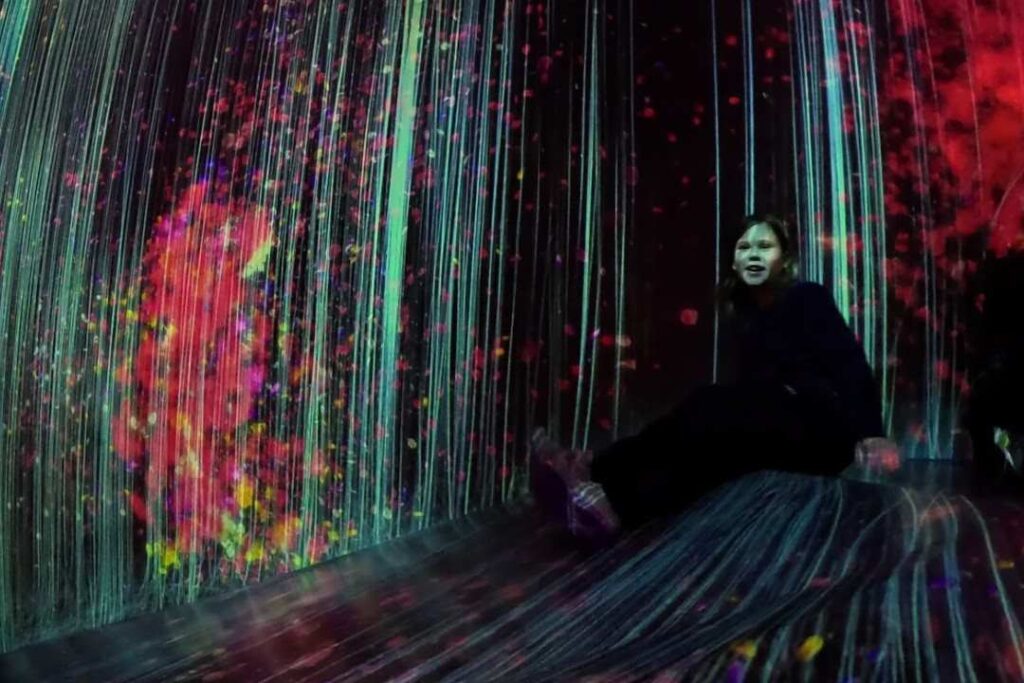
The kids enjoyed teamLab Borderless more, which really surprised us as it’s not as interactive. There is one particular room that is quite large, with a raised section in the middle that you can slide down, and I think this sealed the deal for them. Although our youngest (aged nine at the time) said she liked Borderless more, she struggled with some of the rooms here due to the flashing and sometimes overwhelming lights. If you have a child who is a little sensitive to such things, you’ll need to come prepared with your usual coping strategies.
What to know before visiting teamLab Planets or Borderless with kids
Tickets
You’ll need to book tickets well in advance; don’t leave it until you arrive in Tokyo. To avoid the crowds, book during the first and last two hours on weekdays.
👉 Get your teamLab Planets tickets here.
👉 Get your teamLab Borderless tickets here.
What to wear
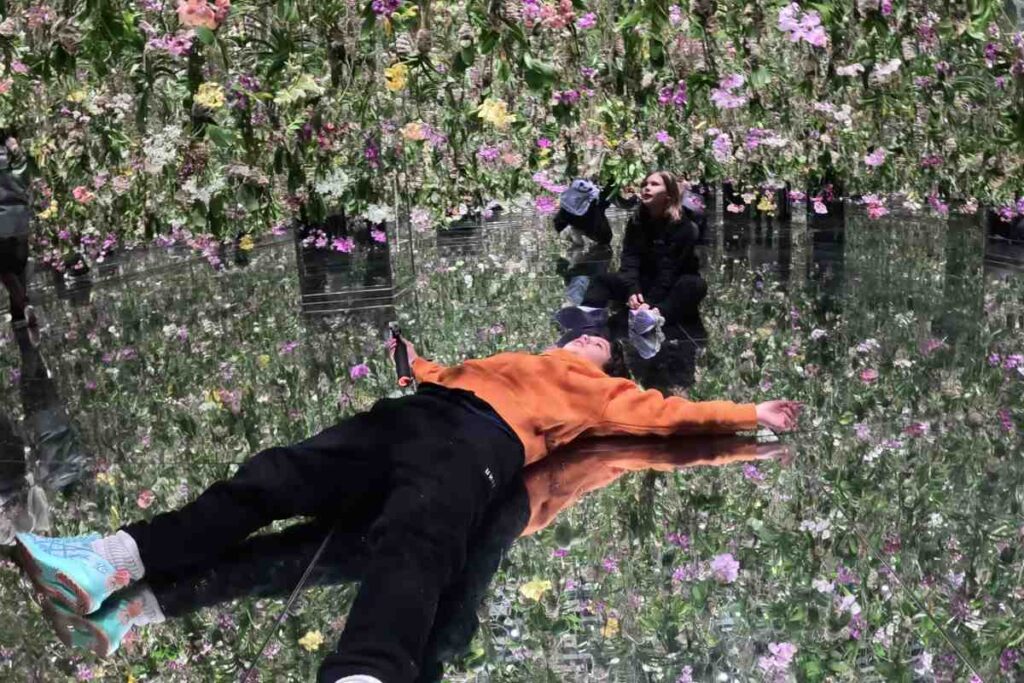
TeamLab Borderless simply requires comfortable clothes that you can walk around in. However, for teamLab Planets, you’ll need to wear shorts or pants you can roll up above your knees and easily removable shoes. Don’t wear skirts or dresses unless you are wearing shorts underneath, as a few of the exhibits have mirrored floors.
Age suitability
TeamLab planets will be harder to manage for toddlers, as you’ll need to carry them through the water section. If you’re happy to do this, go for it!
Food
There are no restaurants within the exhibition, and once you’ve left, you can’t go back in. So, make sure everyone is well fed before you arrive.
What to bring
Bring a small towel and a change of clothes in case your kids get their shorts wet. A camera is allowed, but your flash, selfie-stick, GoPro handle and tripod/monopod are not.
There’s an app for that
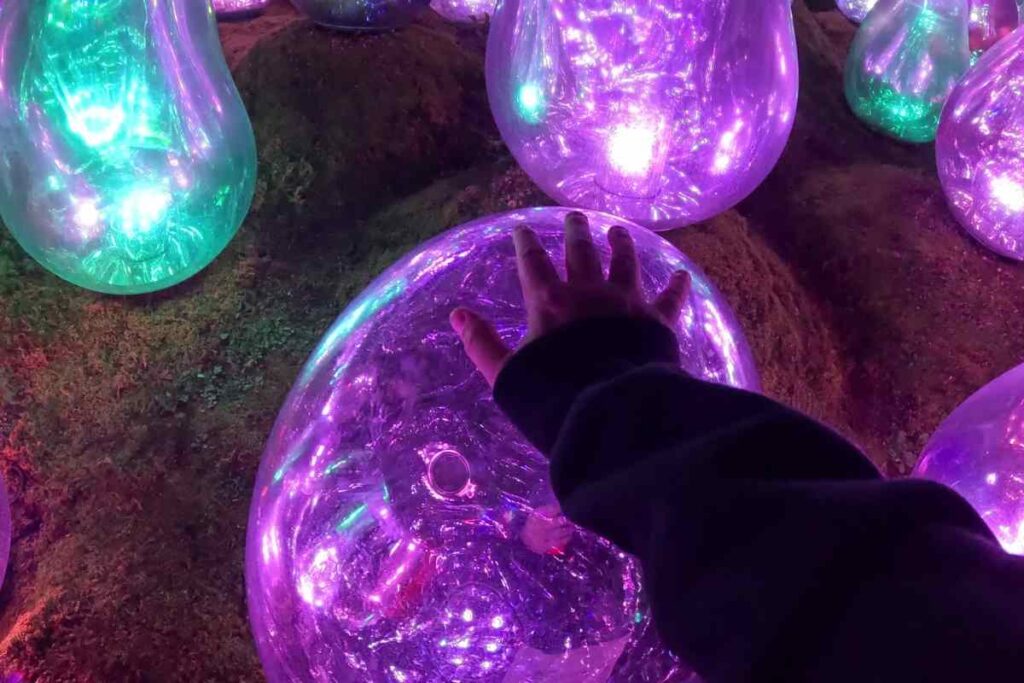
Download the teamLab app before you go, as some of the exhibits are extra interactive:
Final verdict: teamLab Borderless or Planets for families?
If you can only choose one, here’s the simple breakdown:
- Best for toddlers: teamLab Borderless
- Best for primary school kids and older: teamLab Planets
- Best overall for most families: teamLab Planets
- Best if your child is sensitive to crowds or chaos: teamLab Planets
For our family, the adults preferred Planets for its interactivity, while the kids loved Borderless for its sense of exploration.
If you have the time, both are absolutely worth doing. But if you’re choosing just one, Planets is the more memorable experience for most families.
Tickets, locations and practical info
Locations with Google Map links
- teamLab Planets – Google Map Link here
- teamLab Borderless – Google Map Link here
Nearest train stations
- teamLab Planets – 1 minute on foot from the North exit of Shin-Toyosu Station (Tokyo Waterfront New Transit Waterfront Line Yurikamome Line) and 5 minutes on foot from Shijoumae Station and Toyosu Market (Tokyo Waterfront New Transit Waterfront Line Yurikamome Line).
- teamLab Borderless – 2 minutes walk from Exit 5 of Kamiyacho Station on the Tokyo Metro Hibiya Line. Kamiyacho Station on the Hibiya Line is a subway station. After exiting Exit 5, do not go up to the ground level, but continue through the underground passage. Alternatively, it’s a 7-minute walk from Exit 4 of Roppongi-Itchome Station on the Tokyo Metro Namboku Line.
Ticket links
- 👉 Get your teamLab Planets tickets here.
- 👉 Get your teamLab Borderless tickets here.
Opening hours
- teamLab Planets – 9:00 am to 10:00 pm daily. The last entry is one hour before closing. You may have to wait 3 – 60 minutes to be admitted to the venue. Check the website for planned closures.
- teamLab Borderless – 9:00 am – 11:00 pm daily. The last entry is one hour before closing time. Check the website for planned closures.
Website links
Videos and reels
FAQs: teamLab Tokyo with kids
It depends on your child’s age. teamLab Borderless is easier with toddlers, while teamLab Planets is usually more exciting for older kids thanks to its interactive elements like the water rooms.
Yes, but it can be tricky with toddlers. You’ll need to carry them through water sections and navigate dark spaces, so it’s better suited to kids aged 6 and up.
Yes. Borderless is generally easier with younger children as there’s no water component and the layout is more open, allowing kids to explore freely.
In our experience, teamLab Planets felt slightly less overwhelming. Borderless can feel more intense due to its size, crowds and constantly changing light displays.
Allow around 2 to 3 hours for teamLab Planets and about 3 hours for teamLab Borderless, depending on how quickly you move through the exhibits.
Wear shorts or pants that can be rolled above the knees, as you’ll walk through water. Avoid skirts or dresses unless wearing shorts underneath due to mirrored floors.
Yes. Both teamLab Planets and Borderless often sell out, so it’s best to book your tickets before arriving in Tokyo.
No. Strollers are not allowed inside either venue, but there are designated stroller parking areas outside.
This article contains affiliate links to products. We may receive a commission for purchases made through these links.
Where to next?
📌 Save this article to Pinterest so you’ll have it handy when planning your own trip.
Let me know what you think!