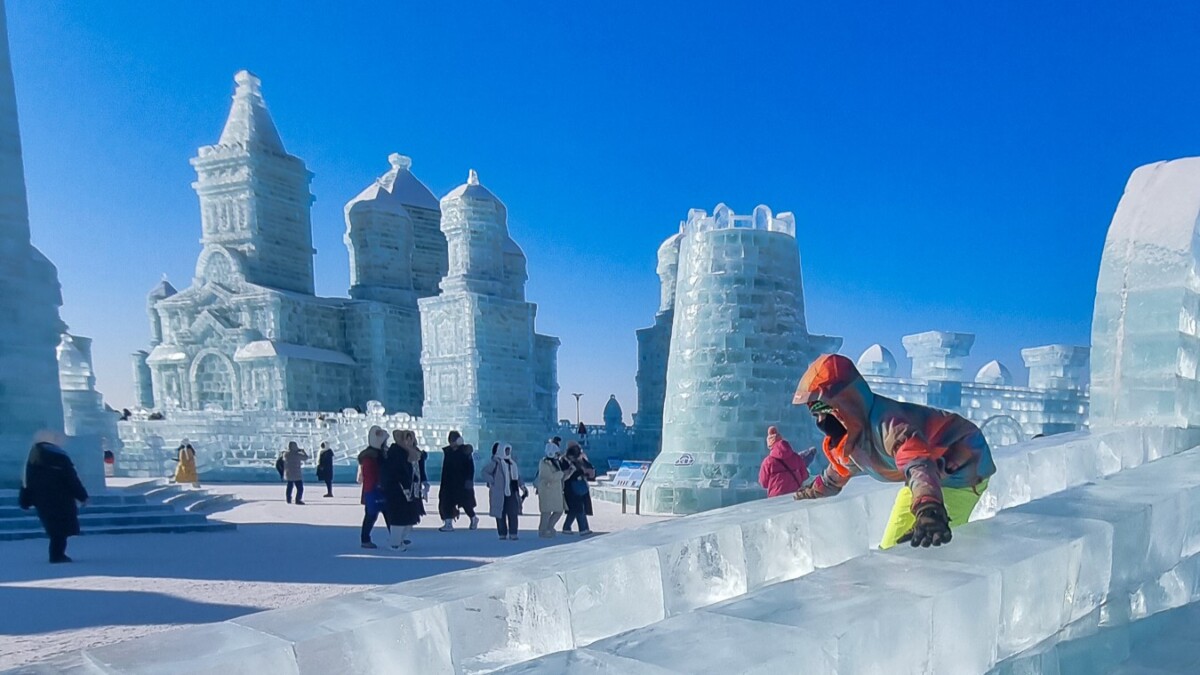
If you’ve ever searched “Harbin Ice Festival” and wondered if it’s actually worth travelling across the world for (especially with kids), you’re not alone.
Known as the largest ice and snow festival in the world, this winter event in northern China features entire cities made from ice, massive snow sculptures and temperatures that regularly drop below -20°C.

But what is it really like to visit and is it realistic for families?
After visiting once pre-kids and then returning 14 years later with our children, here’s what you need to know.
Harbin Ice Festival
The Harbin Ice Festival (officially the Harbin International Ice and Snow Sculpture Festival) is held every year in Harbin, China, typically from early January to late February.
- Location: Harbin, Heilongjiang Province, China
- Temperature: Around -10°C to -25°C
- Main attractions: Ice and Snow World, Sun Island Park, Zhaolin Park
- Family friendly: Yes, but very cold – proper gear is essential
- Recommended time: 2-3 days
Keep reading for what it’s actually like visiting with kids.
If you’d prefer to listen to this story on the Harbin Ice Festival, simply hit play on the Podcast below:
Over a decade ago, I watched men and women clad only in swimwear dive into a pool carved from a frozen river. The outside air temperature was minus ten degrees Celsius (warm for that time of year), and these brave souls swam all the way to the other side, pulled themselves out, and slid their feet into some slippers while a robe was placed over their shoulders.
Now, 14 years later in the same city, this time with kids in tow, I wondered if I would witness this fascinating spectacle again. You see, it’s all part of the fun that is the International Ice and Snow Sculpture Festival, held once a year in the city of Harbin in China’s beautiful northeast.
What is the Harbin Ice Festival?
The Harbin Ice Festival, officially known as the Harbin International Ice and Snow Sculpture Festival, is one of the largest winter festivals in the world. Held each year in Harbin, in northeast China, it transforms the city into a frozen playground filled with massive ice castles, intricate snow sculptures and entire themed worlds built from ice.
Unlike many festivals where you simply look from a distance, Harbin is incredibly interactive. You can walk through ice structures, slide down ice slides and explore huge illuminated displays that feel more like a winter theme park than a traditional exhibition.
For families, that’s a big part of the appeal. It’s not just something to see – it’s something to experience.
When is the Harbin Ice Festival held?
The Harbin Ice Festival typically runs from early January through to late February each year, depending on weather conditions.
The official opening is usually in early January, but many of the attractions begin operating from late December. If you want to see the sculptures at their best, January is the ideal time to visit, when everything is fully built and the temperatures are cold enough to keep the ice structures in perfect condition.
We start with the same frozen river, the Songhua, that captivated me completely last time we were here. Except this time, it’s buzzing with people of all ages enjoying the attractions on the ice. Chinese ballads are blasting from portable speakers as we zip down ice slides on rubber tyres, drive donuts in a Can-Am on the frozen ice and decline many an offer for other rides, such as being pulled on a giant inflatable behind a 4WD on the ice.
Is the Harbin Ice Festival good for families?
Yes – but with a few important caveats.
The Harbin Ice Festival is incredibly family-friendly in terms of activities. Kids will love the ice slides, snow play areas and the sheer novelty of being in a real winter wonderland. Unlike many large-scale events, this is not a “look but don’t touch” experience and children are encouraged to climb, slide and explore.
However, the extreme cold can be challenging, especially for younger kids. Temperatures regularly drop below -20°C, which means you’ll need proper winter gear and a flexible itinerary that allows time to warm up indoors.
If you plan it right, though, it’s one of those experiences kids will talk about for years.
Minus 20 degrees… brrrrr
At minus 20 degrees, we are suitably dressed with thermals, mid-layers and snow suits, but Mother Nature is a force to be reckoned with in this part of the world, and the cold finds a way to creep in. We slip into a small snack shop set up on the ice, and I buy a hot ginger Coke to warm up. I’m not a fan, but it does the job it’s supposed to, which is to warm me up from the inside out. Even if I do feel a bit sick afterwards.
Although the frozen Songhua River features mightily in Harbin’s Landscape, it’s not the main attraction of the Harbin Ice Festival. For that, you need to head to Ice and Snow World, Sun Island Park and Zhaolin Park.
What to wear at the Harbin Ice Festival
Dressing properly for the Harbin Ice Festival isn’t optional – it’s essential.
Temperatures can drop as low as -25°C, and the cold has a way of creeping in no matter how well prepared you think you are. We found layering to be the key.
Here’s what we recommend:
- Thermal base layers (top and bottom)
- Mid-layers such as fleece or wool
- A good quality insulated jacket
- Snow pants or waterproof outer layers
- Thick socks (bring extras)
- Insulated boots with good grip
- Gloves
- Beanie and scarf or neck warmer
For kids especially, having spare gloves and socks can make a huge difference to how long they last outside before needing a break.
Ice and Snow World, Harbin Ice Festival
Straight from the pages of a fairy tale, Ice and Snow World at the Harbin Ice Festival features castles, slides and sculptures all made entirely from – you guessed it – ice. They are not just for viewing from behind a rope, either; many of them can be walked over and through. Carefully, of course, because stairs made of ice require a degree of caution.
In a world filled with technology that can sometimes cause a divide between the generations, it’s nice to see the ice slides being the firm favourite from toddlers through to grandparents. You don’t need any special equipment for the smaller ones; you simply slide down on your snow boots or your bottom. Often, unintentionally, both. At 521 metres in length, the largest ice slide is preceded by a long wait, and only those over the age of 14 years are allowed to attempt it.
Chinese ballads feature heavily once again, as does the sound of our feet crunching in the snow. Despite the crowds, the landscape is a pristine snowscape with not a single wrapper of rubbish to be seen. Children are squealing in delight as they are pulled around the complex on tyres by their parents, and I am happy to discover that this time around, the cold is a lot easier to manage with the addition of hot taps in the public toilets and a shopping centre with a food court, all heated of course.
Bemoan the squat toilet all you want, but with temperatures now bordering on negative 25 degrees Celsius, the last thing I want to do is have my bare backside make contact with a freezing cold toilet seat. Although mastering the squat with this many layers takes skill and a few swear words uttered under my breath.
Foreigners can be a bit of a novelty sometimes…
At age 12, my son attracts the attention of a few Chinese mothers with young girls throughout the day, the mothers fawning over his hazel eyes and ridiculously long eyelashes. They call their daughters over for a look, embarrassing both sets of kids in the process. I giggle to myself that if he were to come back in another few years, he might need a chaperone.
Sun Island Park, Harbin Ice Festival
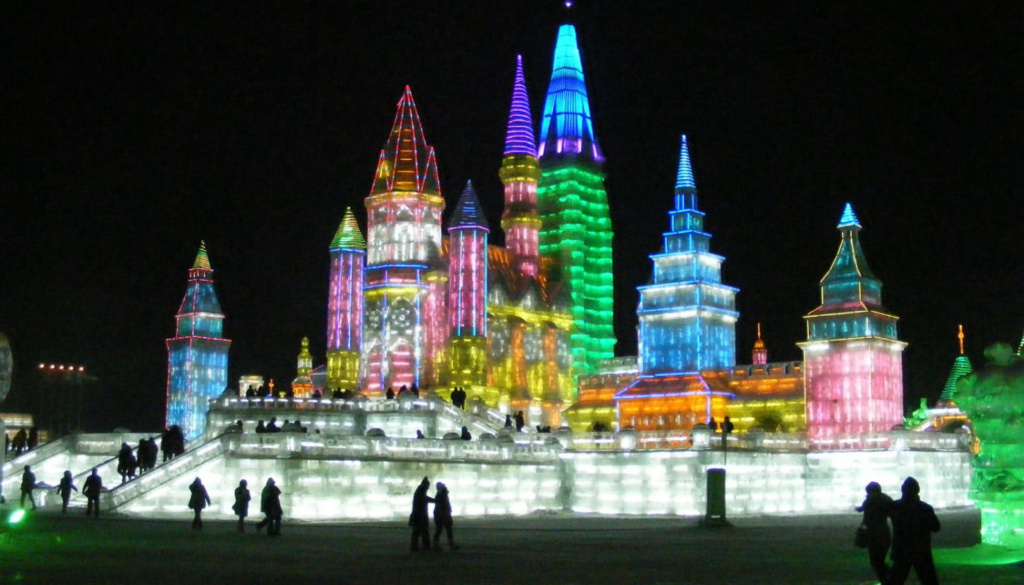
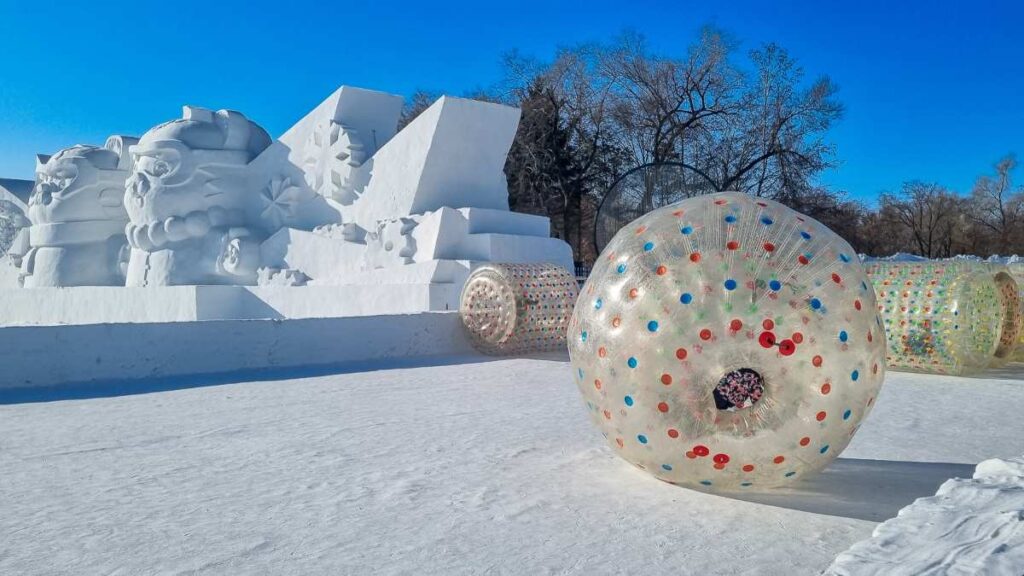
Not too far away is Sun Island Park, home to the international snow sculpture competition part of the Harbin Ice Festival. Here you will find ice and snow sculptures of gigantic proportions. In fact, in 2007, a sculpture here was awarded a Guinness World Record for the largest snow sculpture at 200m long and 35m high! While most of the structures in Ice and Snow world are made from hard ice, here, the sculptures appear more fluffy and snow-like.
Ice and Snow Sculptures from all over the world are represented here, heavily influenced by popular culture, with many movie characters and iconic imagery on display.
Much like last time, the entrant’s sculptures are mind-boggling, and I enjoy this much more than Ice and Snow World, which gives off more theme park vibes. Sun Island Park feels more family fun, with fewer crowds, virtually no waiting in lines and a pleasant absence of loud Chinese ballads blasting through the speaker. Instead, there is a free live concert with dance music, where we join in dancing on the ice.
We also slide down free ice slides and jump into a zorb ball for the first time. Maneuvering the Zorb Ball is physically much harder than I envisioned, and isn’t helped by the heavy boots and many layers of clothes I am wearing. I require help to get out by the attendant, much to the amusement of my husband.
Zhaolin Park, Harbin Ice Festival
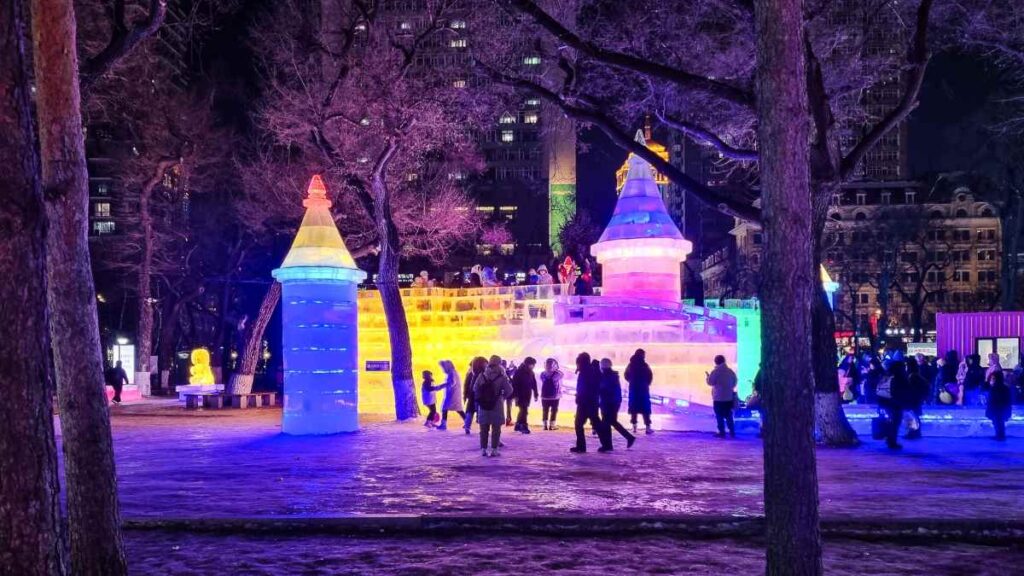
By now, we’re starving, but the kids are finding the cultural differences in food a little hard at this point, so we grab a cab to a Pizza Hut near Zhaolin Park, where a robot delivers our order. Zhaolin Park is an underrated attraction of the Harbin Ice Festival, and surprisingly, it’s free. Despite the below-freezing temperatures, it’s best to visit at night because the ice sculptures, lanterns and slides are lit up with coloured lights.
Here we discover a new dessert, strawberries on a stick coated in toffee and completely frozen. It’s ridiculously sticky but is the first of a few desserts we find in Harbin that quickly become favourites. Chinese ballads once again feature in the background while we navigate an icy maze and watch the kids run up and slide on their boots on a particularly slippery section. I’ll never grow tired of watching the smartly dressed elderly couples strolling through the park, arms locked at the elbows.
Cable Car and Central Street
With the three major attractions of the Harbin Ice Festival done and dusted, we set out to stroll down the well-known Central Street (Zhongyan Street). While ice sculptures don’t feature, this cobblestone pedestrian-only street has its own charm with Russian-influenced architecture, overhanging decorations, a sea of black, white, and red snow jackets, and the discovery of another new dessert, a Russian-style bread shaped into a cone and filled with soft-serve ice cream – Chimney Bread.
At the end of the stroll, we find ourselves back on the Songhua River, looking up at a Cable Car that we rode all those years ago across the frozen river when it was just the two of us. It seemed a little rough around the edges back then, but all of that appears to have been smoothed over with updated cable cars and a tourist-friendly ticket booth. What once was a cold climb up some concrete stairs to the cable car departure point is now filled with cheerful heated sweets shops just asking to add kilograms to your waist, and when you are deposited at the Russian Village on the other side of the Songhua, its even worse, as the gondola officially disembarks at a ‘chocolate castle’, where you guessed it, chocolate abounds.
Try to time your return trip just after the sun goes down!
After getting lost in the village, the sun has gone down by the time we take the cable car back over the other side of the Songhua River. Harbin city and the ice festival lights are surreal from this height, as is the reality of how large the frozen river actually is. We look down to see the 4WDs from days ago still merrily towing people around on the ice, albeit now toy-sized, and I remember that 14 years ago, the rides were limited to a few Clydesdale horses and some odd-looking sled bikes. How times have changed.
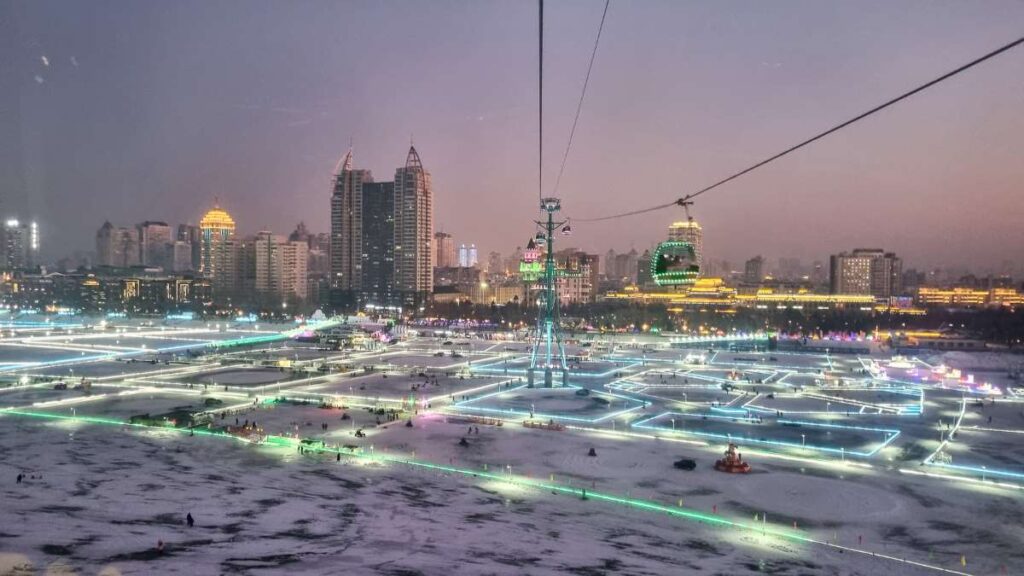
But fortunately, some things haven’t changed, like the beautiful Russian-influenced Sophia Church, the Chinese ballads blasting through the speakers, the sounds the snow makes when it crunches under your boots and the hum of people having a good time at a joyous time of year in an environment that is no less than brutal. These things will never leave me, and really, that’s the whole point of travelling so far for an experience such as this.
Harbin Ice Festival tickets and costs
The Harbin Ice Festival is spread across several main attractions, each with its own entry fee.
The key sites include:
- Ice and Snow World (the main illuminated ice park)
- Sun Island Park (snow sculpture exhibitions)
- Zhaolin Park (smaller displays, free entry)
Ticket prices can vary depending on the time of year and whether you visit during peak periods, but expect to pay for each major attraction separately.
It’s also worth noting that most payments in China are now made via mobile apps like Alipay or WeChat, so setting these up before your trip will make things much easier.
WiFi
Using apps means you need to use data on your phone when you’re out and about and away from the hotel WiFi. We used Airalo for a China eSIM as it’s more cost-effective than international roaming fees. For under AUD$60, we were able to get unlimited data to use in China for 10 days, and were also able to let the kids use the hotspot off the phone when they needed downtime.
Language
English is not widely spoken, and you will need to use Google Translate to communicate. Again, you will need data on your phone to do this.
Tips
Don’t squeeze the Harbin Ice Festival into one or two days with the kids if you don’t have to. The lower temperatures mean that you need to allow extra time to duck inside and warm up, and while all that snow is a lot of fun, it’s also exhausting. Save the big ticket attractions to one per day so everyone has some downtime in the arvos before going out for dinner.
FAQs about the Harbin Ice Festival
Yes – it’s one of the most unique winter experiences in the world, especially if you’ve never seen large-scale ice sculptures before. It combines art, entertainment and extreme weather into one unforgettable experience.
Temperatures typically range from -10°C to -25°C and can feel even colder with wind chill.
We recommend at least 2 to 3 days to comfortably explore the main attractions without rushing.
The festival takes place in Harbin, the capital of Heilongjiang Province in northeast China.
Yes – but you’ll need proper winter gear and regular warm-up breaks.
This article contains affiliate links to products. We may receive a commission for purchases made through these links.
Where to next?
Let me know what you think!