Over the past two years, one destination has dominated conversations with Australian families: Japan.
From snow trips to neon-lit city breaks, Japan has become the benchmark for what families want from Asia. It offers safety, ultra-efficient public transport, clean public spaces, cultural depth without discomfort, and immersive attractions that genuinely excite both kids and adults. When you combine this with world-class food, pop-culture and theme parks, it’s easy to understand why demand has surged.
Although Japan is an incredibly unique destination, if we were to strip Japan’s popularity back to its fundamentals, we would find that many of the core drivers behind its success aren’t uniquely Japanese.
Many of the qualities families are seeking, such as safety, infrastructure, ease of navigation, cultural richness, amazing food and world-class attractions are equally present in Singapore. And in some ways, Singapore delivers them in a more manageable format.
The infrastructure families crave
Families like reassurance when they book a holiday. Japan works because it feels predictable despite its cultural differences and the culture shocks are rarely uncomfortable. Public transport runs like clockwork, the streets feel orderly and convenience stores have food that appeals to families.
Singapore offers that same comfort factor.
Its MRT (Mass Rapid Transit) system is more straightforward and also runs like clockwork, English is widely spoken, public spaces are safe and easy to navigate, airport transfers are much shorter and the city is compact. In fact, you can fit the entirety of Singapore inside Tokyo.
For families testing the waters of Asia, particularly those travelling with younger children, that simplicity is a huge selling point. Where Japan can require multi-city rail planning and internal transfers, Singapore allows families to experience a wide range of attractions within a small geographical footprint. This means less travelling once families arrive, less fatigue and itineraries that feel achievable.
The “wow” factor is already there
One reason Japan has resonated so strongly is its ability to blend culture with spectacle. Immersive digital art, theme parks, pop culture and Japanese food. These are all high-impact and sought-after experiences.
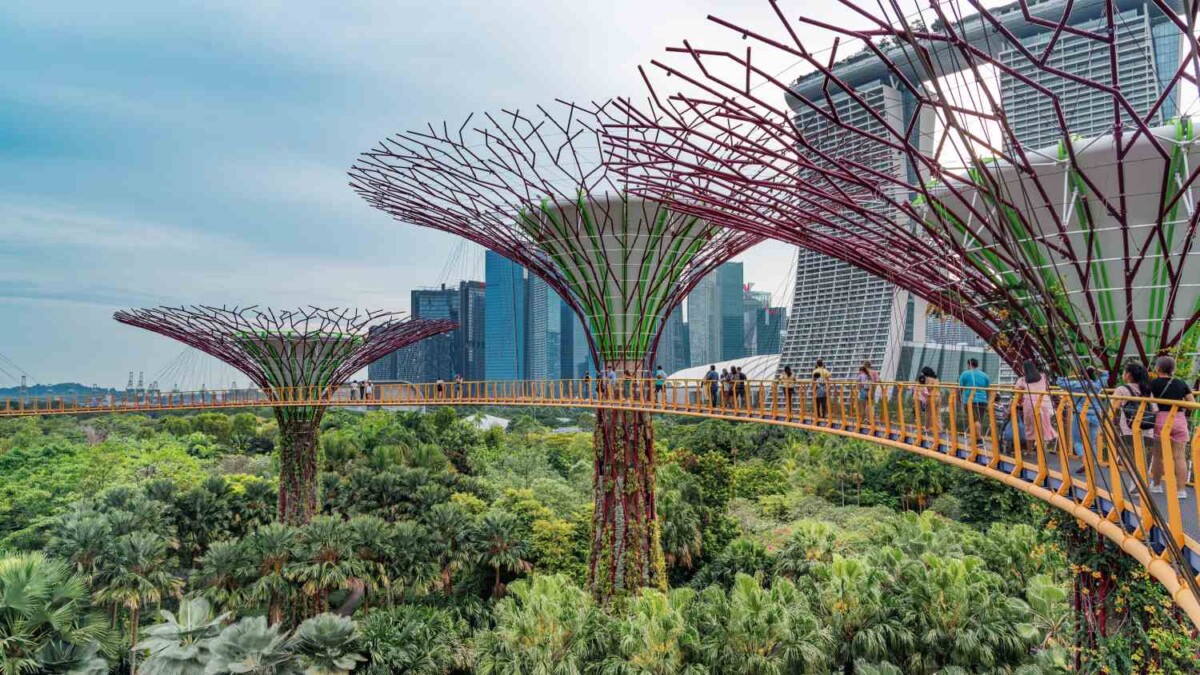
Singapore isn’t lacking here either, also offering the same kind of interactive art experience by teamLab that families love in Tokyo. It has an entire garden dedicated to young children in the Jacob Ballas Children’s Garden, the world-renowned Gardens by the Bay and an entertainment hub at Sentosa, home to Universal Studios Singapore, beaches, attractions and family-friendly resorts.
It offers wildlife parks, science-focused attractions, Marina Bay skyline experiences and green walking trails. All of these major drawcards are geographically close, allowing advisers to package efficient four- or five-night itineraries that are full without being exhausting.
Compact without compromise
There’s another subtle advantage for families in Singapore. While Japan can feel epic, Singapore can feel more achievable. For some families (especially those who are time-poor or not confident travellers), Japan’s scale can be intimidating with language barriers, train logistics and hotel moves. Singapore removes those friction points while still delivering a uniquely Asian experience.
Changi Airport strengthens this even further. With Jewel’s indoor waterfall, dining precincts and family-friendly amenities, arrival and departure become part of the experience rather than a stress point.
From a commercial perspective, Singapore also integrates seamlessly into broader itineraries. It works as a standalone break or as a long stopover as part of a Thailand, Vietnam or Europe routing.
Sustainability is shifting destination choices
Another trend shaping family travel decisions is sustainability. Singapore has invested heavily in urban greenery, environmental innovation and conservation. It was the first country certified as a sustainable destination by the Global Sustainable Council in 2023. Areas such as Pulau Ubin provide a contrast to the city skyline, offering families insight into traditional village life and natural ecosystems.
As more parents look for travel experiences that feel educational as well as entertaining, Singapore’s positioning as a green, forward-thinking city adds depth to its appeal.
Why this matters right now
Japan’s popularity shows that families are willing and eager to explore Asia when the infrastructure is supportive. However, strong demand inevitably leads to pricing pressure, crowding, and capacity constraints.
The market will evolve and repeat travellers will look for the next destination that offers similar reassurance but fresh appeal. Singapore fits that gap for families.
It delivers modern Asia without logistical complexity, it offers attraction density without geographic spread, it combines cultural diversity with English-speaking ease, and it’s backed by strong aviation connectivity and ongoing tourism investment.
I’m not saying that Singapore will replace Japan when it comes to family travel in Asia, nor should it. But for advisers and industry stakeholders watching family demand patterns, it represents the next logical growth market.
Let me know what you think!